
Grant Management Software: Features, Benefits and How It Works
31st August 2026
5 min read
by Taru Bhargav
Grant management software may be the solution you have been hearing about. But where do you start? And with platforms supporting everything from applications and assessments to payments, acquittals and impact reporting, where does the category stop?
When grant programs grow, the work rarely sits neatly in one place. Applications may arrive through one system, assessments may happen across spreadsheets and email, approvals may depend on several teams, and reporting can continue long after funding has been awarded.
This guide breaks the category down from the beginning, including how grant management software works, who uses it, the features and benefits to look for, what implementation involves and the questions to consider when choosing a platform.
It is written for organisations administering funding across government, philanthropy, not-for-profits, universities, research, corporate giving and community investment.
Let’s get started.
What is grant management software?
Grant management software is a system used to manage the processes, information and reporting involved in administering a grant or funding program.
The terms grant management software, grant management system and grant management platform are often used interchangeably. While individual products vary in scope, they generally refer to software that brings the different stages of the grant lifecycle into one structured environment.
That includes the work that happens before funding is awarded, such as setting up a grant round, collecting applications and coordinating assessments, as well as the work that follows, including agreements, payments, milestones, acquittals and outcome reporting.
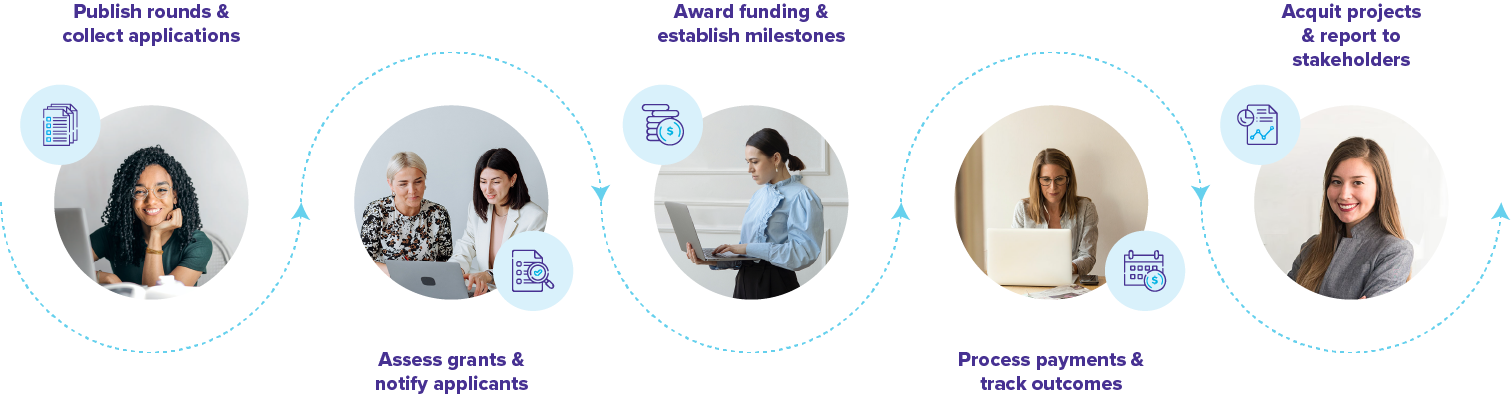 That is the definition. The easier way to understand it, though, is to look at how grant management software might be used in practice.
Scenario 1
A local council is running a community grants program with several funding streams. Applications are submitted online, but staff still export the information into spreadsheets, email documents to assessors and manually follow up on missing information.
With grant management software, the council can manage applications, eligibility checks, assessments, approvals and applicant communication within one process. Once funding is awarded, the same system can be used to track agreements, payment milestones and acquittals.
Scenario 2
A philanthropic foundation manages a number of grants, but each one runs for several years and has different reporting requirements. The challenge is not the volume of applications. It is keeping track of commitments, progress reports, outcomes and conversations with grantees over time.
In this case, grant management software creates a central record for each grant, including the original application, funding decision, agreement, reporting schedule and outcome data. This gives the foundation a clearer view of both individual grants and the wider funding portfolio.
Scenario 3
A National Research Council coordinates multiple funding rounds involving leadership teams, peer reviewers, finance teams and the government departments distributing the funds. Each round may have different eligibility rules, assessment criteria and approval pathways.
Grant management software can be configured around those requirements, helping the team collect consistent information, assign reviewers, record decisions and monitor funded projects after approval.
The exact process will vary between government, philanthropy, research, community investment and other funding environments. The role of the software remains broadly the same: to bring the grant lifecycle into a more structured, visible and manageable system.
These are only three examples and not exhaustive. Grant management software is also used by corporations running CSR, sponsorship and community investment programs, not-for-profits administering funding on behalf of partners, and NGOs managing humanitarian, international aid or disaster relief programs.
The details may differ, but the underlying challenge is similar, i.e bringing applications, decisions, agreements, payments, reporting and outcomes into one process that people can see and manage - regardless of their location.
Why do organisations need grant management software?
If parts of the earlier scenarios felt familiar, you can probably already see where grant management software may help in your organisation. But the value goes beyond bringing scattered processes into one system.
Here is what that looks like in practice:
1. Create one reliable source of grant information
The problem is not usually that grant information does not exist. It is that different parts of it sit across application platforms, spreadsheets, inboxes, shared drives and individual calendars, making it difficult to see the complete and current record.
A grant management platform creates a central record that follows an application from submission through to assessment, award, payments, reporting and acquittal. Authorised users can see the relevant documents, decisions, deadlines and communications without piecing the history together across multiple systems.
This becomes particularly valuable when:
- several teams contribute to the same funding program
- grants run across multiple years
- staff change roles or leave the organisation
- an organisation manages several rounds or funding streams
- auditors, boards or executives need evidence behind a decision
- grant data needs to be combined for portfolio or impact reporting
A central record also makes grant data more useful. Take the ACNC’s 12th Australian Charities Report. Across its charity-size tables, Australian charities reported approximately $12.6 billion in grants and donations during the 2024 reporting period, including around $10.1 billion distributed within Australia.
At that scale, incomplete or inconsistent records can make it harder to track funding across programs, meet reporting requirements and understand where money has been directed.
2. Reduce the administrative burden on grant teams
How often does someone need to chase an assessor, follow up on an approval, remind a grantee about a milestone report or check whether an acquittal is overdue?
Those tasks may appear small in isolation, but they accumulate across the pre-award and post-award stages of a funding program.
Manual administration can appear throughout the grant lifecycle, including:
- checking applications for missing or ineligible information
- transferring applicant or researcher details into assessment documents
- assigning applications to assessors, reviewers or panels
- following up on scoring, conflicts of interest and delegated approvals
- preparing funding agreements and award correspondence
- tracking payments, milestones, variations and reporting dates
- reminding grantees, research teams or community partners about post-award obligations
- combining program data for acquittal, portfolio and impact reporting
Grant management software can structure or automate parts of this work. Applications can be routed according to eligibility or program rules, pre-award tasks assigned to the appropriate reviewers, reminders triggered by due dates and documents populated using information already held in the system.
For a national research office, that could mean fewer manual handovers between researchers, reviewers, finance teams and senior approvers. For a foundation or CSR team, it could mean spending less time chasing progress reports across a portfolio of community partners. For a government or not-for-profit program, it could mean clearer ownership across assessment, approval, payment and acquittal workflows.
The value is not limited to saving staff time. Manual processes also make it easier for information to be entered inconsistently, deadlines to be missed and work to depend on one person knowing what happens next.
A configured workflow gives each pre-award and post-award task an owner, a status and a due date, making the process easier to manage even when teams are small or several programs are running at once.
That being said, automation should support, not replace, human judgement. Funding priorities, assessment decisions, and relationships with applicants or grantees still require people. And that’s what the software does so grant teams can spend more time on the work that needs their expertise.
3. Create more consistent pre-award and post-award workflows
Every funding program has its own rules, but that does not mean every grant round should be rebuilt from scratch.
Grant management software gives organisations a consistent structure for moving work through the pre-award and post-award lifecycle. The stages may stay broadly familiar, while the criteria, people and decisions within them change from one program to the next.
|
Lifecycle stage |
What stays consistent |
What can vary by program |
|
Pre-award |
Applications are received, checked and assigned for review |
Eligibility rules, assessment criteria, reviewer groups and approval pathways |
|
Award |
Decisions are recorded, and funding arrangements are issued |
Delegations, agreement terms, funding amounts and conditions |
|
Post-award |
Progress, payments and obligations are monitored |
Milestones, reporting schedules, variations, acquittals and outcome measures |
A research study round, a community foundation program and a corporate giving initiative may all follow this broad sequence, but they should not be forced into the same process. A configurable grant management system allows each program to reflect its own requirements while keeping responsibilities, decisions and next steps clear.
It is a more reliable way to manage each program from application through to grant closure.
4. Strengthen governance and audit readiness
Who assessed the application? Were conflicts of interest declared? Why was funding approved, declined or varied? And can the organisation retrieve the records that support those decisions?
These questions may arise during an internal review, an external audit, a board discussion or a handover between team members. A grant management system helps preserve the assessment history, approvals, correspondence, agreement changes and reporting activity connected to each grant.
It can also retain changes to application data, reviewer activity, decision records and workflow history, creating a clearer record across the pre-award and post-award stages.
Good governance still depends on clear policies, appropriate delegations and sound judgement. The software makes the evidence behind those processes easier to capture, follow and retrieve.
5. Improve the applicant and grantee experience
The applicant and grantee experience is shaped by how much information people are asked to provide, when they are asked to provide it and how clearly each stage of the process is explained.
Asking for too much information too early creates unnecessary effort, while unclear post-award requirements make it harder for grantees to meet their obligations.
This is why the Australian Research Council’s 2026 proposed reforms to the National Competitive Grants Program are relevant. By reducing the information collected at the application stage and streamlining post-award administration, the reforms are designed to make the process easier for researchers, universities and partner organisations to move through.
Grant management software can support the same principle by matching forms, communications and reporting requirements to each stage of the grant lifecycle.
|
Stage |
What a clearer experience can include |
|
Pre-award |
Relevant eligibility questions, save-and-return applications, document uploads and submission confirmation |
|
Assessment |
Requests for clarification, application status updates and communication through one channel |
|
Award |
Decision notifications, funding agreements and clear next steps |
|
Post-award |
Milestone reminders, progress reporting, variation requests, acquittals and outcome reporting |
For the funding organisation, a clearer process can reduce incomplete applications, routine status enquiries and repeated follow-up. For applicants and grantees, it makes it easier to understand what is required now, what has already been provided and what happens next.
6. Support better grant reporting and decision-making
The Australian Research Council received 1,133 applications for Discovery Projects funding commencing in 2025 and approved 536 projects, resulting in a success rate of 47.3%. Its published selection report also compares funding amounts and success rates with the previous round.
That is the difference between reporting on a funding total and understanding the program behind it.
Grant management software can bring together application, assessment, award and post-award data so organisations can answer questions such as:
- Who applied, and who received funding?
This may include funding by location, program, applicant type, priority area or demographic group. - How did applications move through the process?
Teams can examine application numbers, eligibility outcomes, assessment progress, approval rates and processing times. - Are funded activities progressing as expected?
Post-award reporting can show upcoming milestones, overdue reports, payments, variations and acquittal status. - What did the funding achieve?
Outputs, outcomes and program indicators can be connected to the original grant, rather than collected separately at the end of the program.
The value is not another dashboard for its own sake, but having grant data in a form that program teams, executives, boards and funding partners can use to review performance, respond to reporting requirements and make more informed decisions about future rounds.
What features should grant management software include?
Now that you have a clearer picture of how grant management software can support organisations like yours, the next question is: what should the platform actually be able to do?
The features worth prioritising are the ones that support the full grant lifecycle, from program setup and applications through to assessment, award, payments, reporting and acquittal. The exact mix will depend on your programs, internal processes, reporting requirements and the systems you already use.
It is also worth looking beyond what the software can do today. Grant programs change, reporting expectations evolve and new funding models emerge, so it is important to choose a platform that can evolve with your organisation rather than forcing your team to rebuild the process each time.
Here are the core capabilities to look for:
1. Program and grant round setup
Your grant management software should allow you to:
- Set funding objectives: Define what the program is intended to achieve and connect those objectives to the application, assessment and reporting process.
- Build the program structure: Set up the stages, roles, approval points and information requirements that apply across the grant lifecycle.
- Manage grant round dates: Control when applications open and close, along with key deadlines for applicants, assessors and internal teams.
- Publish guidelines and supporting documents: Make eligibility requirements, program guidelines, templates and other resources available alongside the application.
- Manage multiple programs or funding streams: Run different grant rounds, funding categories or program types within the same platform while keeping their records and workflows distinct.
- Configure fields and workflows: Tailor forms, required information, decision points and approval pathways to suit each funding program.
2. Online applications and applicant portals
A capable grant management platform should make it easy to:
- Create branded online forms: Build application forms that reflect your organisation and funding program, with clear guidance for applicants at each stage.
- Enable save and return: Let applicants begin an application, save their progress and return before the grant round closes.
- Accept supporting documents: Allow applicants to upload budgets, research proposals, letters of support, certificates and other required evidence.
- Use conditional fields: Show or hide questions based on previous responses so applicants only see the information relevant to them.
- Maintain applicant profiles: Store contact details, organisation information and application history so returning applicants do not need to start from scratch.
- Provide status updates and communication: Give applicants a clearer view of submission status, requests for information, decisions and next steps.
3. Eligibility and initial screening
At the initial screening stage, look for software that can:
- Add eligibility questions: Collect the information needed to check whether an applicant or project meets the basic program requirements.
- Apply validation rules: Require essential fields, confirm formats and prevent applications from being submitted when key information is missing.
- Route applications automatically: Direct submissions to the appropriate program, team or review pathway based on configured rules.
- Identify incomplete applications: Flag missing documents, unanswered questions or inconsistent information before assessment begins.
The software can support screening and routing, but funding suitability and final eligibility decisions should remain subject to the organisation’s own review and judgement.
4. Assessment and approval workflows
Once applications move into review, the platform should support:
- Reviewer assignment: Allocate applications to internal assessors, external experts or panel members based on program rules and expertise.
- Scoring and assessment criteria: Set the questions, weightings and evidence requirements used to assess each application.
- Panel processes: Bring together individual scores, comments and moderation outcomes for panel review.
- Comments and supporting documents: Keep assessment notes, attachments and recommendations connected to the application record.
- Conflict-of-interest controls: Record declarations, restrict access where required and reassign applications when a conflict is identified.
- Delegated approvals: Route recommendations to the appropriate decision-maker based on funding value, program type or internal authority.
- Decision records: Record recommendations, approvals, conditions and reasons so the organisation can see how the final outcome was reached.
5. Award and agreement management
After a funding decision is made, the system should help teams:
- Create offer and award records: Record approved funding amounts, conditions, dates and recipient details in one place.
- Manage funding agreements: Prepare, issue and store agreements connected to the relevant grant and funding decision.
- Generate documents: Populate letters, agreements and other award documents using information already held in the system.
- Record conditions of funding: Track the obligations, milestones and reporting requirements attached to each award.
- Manage agreement changes: Record variations, extensions, revised funding amounts and updated conditions throughout the grant term.
- Maintain version history: Preserve earlier versions of agreements and documents so changes can be traced over time.
6. Payments, budgets and milestones
During post-award delivery, useful capabilities include:
- Payment schedules: Record when payments are due and connect them to approvals, milestones or reporting requirements.
- Funding allocations: See how much funding has been approved, committed, paid or remains available across programs and grants.
- Milestone tracking: Monitor key delivery, review and reporting dates throughout the post-award stage.
- Budget tracking: Record approved budgets, expenditure categories and financial reporting data connected to each grant.
- Financial system data exchange: Pass relevant payment and funding information between the grant management platform and the organisation’s finance or ERP system where integrations are available.
- Alerts and overdue actions: Notify staff when milestones, reports, approvals or payment-related tasks require attention.
Grant management software may track, prepare or initiate payment information, but it does not necessarily replace the organisation’s finance or ERP system.
7. Progress reporting and acquittals
For ongoing reporting and grant closure, the software should be able to:
- Collect progress and final reports: Give grantees a structured way to report on delivery, expenditure, milestones and results.
- Manage financial acquittals: Collect evidence showing how grant funds were spent against the approved budget. An acquittal is the process of confirming that funding was used in line with the grant agreement and reporting requirements.
- Accept evidence and attachments: Allow grantees to upload invoices, financial statements, project evidence and other supporting material.
- Set reporting schedules: Assign due dates and reporting requirements based on the grant term, program or milestone plan.
- Manage variations and extensions: Record requests, decisions and revised obligations when a grant changes after award.
- Automate follow-up workflows: Send reminders, assign reviews and escalate overdue reports or unresolved actions.
8. Outcomes and impact reporting
To support portfolio-level reporting, look for a platform that can:
- Define program indicators: Set the measures used to track delivery, performance and progress against funding objectives.
- Capture outputs and outcomes: Record what was delivered and the changes or benefits the funded activity was intended to produce.
- Report across the portfolio: Combine information from multiple grants, rounds or programs to understand performance at a broader level.
- Analyse geographic or demographic data: Review where funding was directed and which communities, sectors or groups were reached where the relevant data is collected.
- Build dashboards and reports: Present funding, milestone, outcome and portfolio information in a format that different stakeholders can use.
- Export data for further analysis: Move grant data into business intelligence, reporting or analytical tools when deeper analysis is required.
Philanthropy Australia notes that timely, high-quality grants data can support collaboration, co-funding and grant strategy. The platform should therefore make reporting data easier to collect, compare and use across the funding portfolio.
9. Security, permissions and audit trails
From a governance and security perspective, the system should provide:
- Role-based access: Control which users can view, edit, assess, approve or report on different records and programs.
- Protection for sensitive information: Restrict access to personal, financial, commercial or research information held about applicants and grantees.
- Audit history: Record changes to data, documents, decisions and workflow activity over time.
- Data storage and residency information: Confirm where information is hosted and whether the arrangement meets the organisation’s privacy, contractual and procurement requirements.
- Authentication and identity management: Support appropriate login controls, multi-factor authentication or single sign-on where required.
- Evidence of relevant security controls: Provide the documentation needed for the buyer’s sector, risk profile and internal review process.
There is no single security standard that suits every organisation. Buyers should assess the privacy, security, hosting and compliance requirements that apply to their sector and procurement environment.
10. Integrations and data exchange
Within the wider technology environment, the platform should be able to:
- Connect with finance systems: Exchange approved funding, payment and budget information without recreating the same data manually.
- Support identity and single sign-on: Work with the organisation’s existing authentication and access-management environment where required.
- Exchange data with CRM or stakeholder systems: Keep applicant, grantee, partner or contact information aligned across relevant platforms.
- Feed business intelligence and reporting tools: Make grant data available for broader organisational dashboards and analysis.
- Connect with document management systems: Store or reference grant documents within the organisation’s existing records environment where supported.
- Use APIs: Enable data exchange with other platforms through documented integration capabilities.
- Import and export data: Move records into or out of the system using suitable formats for migration, reporting, review or backup.
The aim is not necessarily to replace every system already in use. It is to reduce duplicate data entry and allow grant information to move reliably between the platforms that support the wider funding process.
How does grant management software compare with other ways of managing grants?
Dedicated grant management software is not the only way to administer a funding program. Spreadsheets, online forms, shared drives, CRMs and project management tools can all support parts of the process.
The difference is how much of the pre-award and post-award lifecycle they can manage as one connected process.
|
Approach |
Where it can work well |
Where limitations can merge |
|
Spreadsheets and email |
A simple, low-volume or one-off program managed by a small team |
Version control, assessor coordination, approval history, deadline tracking and consolidated reporting become harder as the program expands |
|
Online forms and shared drives |
Collecting applications and supporting documents digitally |
Application data, assessment activity, agreements and post-award reporting often remain disconnected |
|
Project management software |
Assigning internal tasks, setting deadlines and tracking general workflows |
Grant-specific requirements such as eligibility screening, panel assessment, delegated approvals, funding agreements and acquittals may require extensive workarounds |
|
CRM or stakeholder management software |
Managing contacts, relationships, correspondence and engagement history |
The system may not provide the structured pre-award and post-award workflows required to administer funding programs |
|
Grant management software |
Managing applications, assessment, approvals, awards, payments, reporting and acquittals through one grant-specific platform |
Requires investment in configuration, implementation, training and ongoing platform management |
The right approach depends on the complexity of the program rather than application volume alone.
A small portfolio of multi-year research grants with several milestones, payment conditions and reporting obligations may require more structure than a much larger one-off community funding round.
General-purpose tools can still remain useful alongside grant management software, with finance systems continuing to process payments, CRMs holding broader stakeholder relationships and business intelligence platforms supporting organisation-wide reporting, while the grant management platform provides the connected record and workflows that are specific to the funding lifecycle.
How much does grant management software cost?
Grant management software can range from a few thousand dollars a year for a more standardised platform to a tailored investment for organisations managing multiple programs, integrations and complex reporting requirements.
The difficulty is that providers do not all price their platforms in the same way. Some publish a starting subscription, while others calculate pricing according to users, funding distributed, selected modules or implementation requirements.
Here is how Tactiv and five other grant management software providers approach pricing as of August 2026.
|
Provider |
Pricing approach |
What to know |
Official source |
|
Tactiv |
Custom, user-based pricing |
We offer structured pricing as well as tailored plans to suit an organisation’s programs, users and implementation requirements. |
|
|
SmartyGrants |
Funding-based annual pricing |
The annual fee is based on the value of grants, awards or scholarships distributed. Public rate cards are not available to prospective customers. |
|
|
Fountant Grant Lifecycle Manager |
Custom pricing |
No public pricing is available; organisations need to request pricing based on their grantmaking requirements. |
|
|
Optimy |
Published starting price and custom tiers |
The Start plan begins at €650 per month, while the Smart and Professional plans use custom pricing. |
|
|
Submittable |
Custom pricing |
No public pricing is available; organisations need to contact Submittable about the products, capacity and services required. |
A word of caution: These prices are not directly comparable because the inclusions, target organisations and pricing units vary.
One platform may include unlimited users but calculate fees according to the value of funding distributed, while another may price according to users, modules or configuration requirements.
The software licence is also only one part of the investment. When comparing quotes, check whether the proposed cost includes:
- configuration and implementation
- data migration and historical records
- integrations and API work
- administrator, assessor and external-user access
- training and change management
- reporting configuration
- technical support
- additional programs, modules or usage
- future configuration changes
At Tactiv, pricing is based on the number of users, with tailored plans available to suit different program and organisational requirements. Implementation costs are scoped separately and reflect the level of configuration, migration, training and setup required for your organisation.
A lower subscription may suit a straightforward funding program, while an organisation managing several funding streams, approval pathways, reporting models and system integrations may need a broader implementation.
The more useful comparison is not simply which provider has the lowest advertised price, but what the total cost will be to support your funding programs at launch and as they evolve.
How should you choose grant management software?
By this point, you may have a clearer idea of what grant management software can do. Choosing the right platform, however, is less about finding the longest feature list and more about understanding whether the software can support the way your organisation funds, assesses, approves and reports.
Start with the grant lifecycle you need to manage today, then consider what may change over the next few years.
|
What to assess |
Questions to ask |
|
Fit with your funding programs |
Can the platform support your program types, funding streams, users and pre-award and post-award requirements? |
|
Configurability |
Can your team adjust forms, workflows, assessment criteria, reports and approval pathways as programs evolve, or will each change require custom development? |
|
Applicant and grantee experience |
Are applications, communications, agreements, progress reports and acquittals easy for external users to complete and manage? |
|
Reporting and data |
Can the platform collect the information required for program, portfolio, financial and outcome reporting, and can that data be exported for further analysis? |
|
Integrations |
Can it exchange information with the finance, identity, CRM, document management and reporting systems already used by your organisation? |
|
Security and governance |
Does the platform support the access controls, audit history, authentication, hosting and data requirements relevant to your organisation and sector? |
|
Implementation |
What configuration, data migration, testing and internal input will be required before launch? |
|
Training and ongoing support |
What help is available during implementation, after launch and when your programs or team change? |
|
Total cost of ownership |
Beyond the software subscription, what will you pay for implementation, migration, integrations, training, support and future changes? |
Do not assess these criteria only through a standard product demonstration. Ask each provider to show how one of your real funding programs would move through the platform, from grant round setup and application intake to assessment, approval, reporting and acquittal.
This will usually tell you more than seeing a series of isolated features. You can see where the platform follows your existing process, where configuration may be needed and where your team may need to rethink the way work is currently managed.
Implementation should be part of the buying decision rather than something considered after the platform has been selected. Ask who will map your requirements, configure the system, migrate existing records, test workflows and train users, as well as what your internal team will need to contribute at each stage.
At Tactiv, implementation can range from a standard setup to a more specialised configuration, with training available as part of the implementation and ongoing support after launch.
The right grant management platform should fit the way your programs operate now while giving your organisation enough flexibility to support new funding models, reporting expectations and internal requirements over time.
Choosing grant management software is a long-term decision
As this guide has shown, a lot happens across the grant lifecycle, from program setup and assessment through to agreements, payments, reporting and acquittals. The software you choose needs to support that work without adding another layer of complexity for the people using it.
There will always be a learning curve when a new platform is introduced. Teams need time to map their processes, migrate information, test workflows and adjust the way they work, which makes the initial decision particularly important. Moving to another system later can mean repeating much of that work, along with the cost of transferring data, rebuilding integrations and retraining users.
The right platform should therefore meet your current requirements while giving you enough flexibility to adapt as your programs, reporting obligations and funding models change.
At Tactiv, we have seen how much difference the right system can make when the grant management process is already complex. The Ross Trust manages more than 50 active grants across a broad range of community and charitable programs, with a small internal team responsible for everything from assessment through to reporting and acquittals.
Working with Tactiv, the Trust moved to a single system for applications, assessment, contracts and progress reporting, giving the team better visibility across active grants and a more consistent way to capture organisational impact and beneficiary outcomes.
We work with organisations across government, philanthropy, education, not-for-profits and corporate programs to understand the funding processes they need to manage and configure Enquire around those requirements.
Book a demo, and we would love to learn more about your programs, the challenges your team is working through and what you need from a grant management platform.
FAQs
Is grant management software for grantmakers or grantseekers?
Grant management software can refer to two different types of platforms. Some help organisations find and apply for grants, while others help funders administer applications, assessments, awards, payments and reporting.
How long does grant management software take to implement?
Implementation time depends on the complexity of the organisation’s programs, data migration, integrations, configuration and testing requirements. A straightforward setup may be relatively quick, while a more complex implementation across multiple programs and systems will usually take longer.
What happens to existing grant data when changing systems?
Existing grant data can usually be migrated into the new platform, including active grants, applicant details, documents, payment records and reporting history. The scope of migration should be agreed during implementation because not every historical record will necessarily need to be transferred.
Is grant management software suitable for smaller grant programs?
Grant management software can suit smaller programs when the process involves multiple assessors, ongoing reporting, compliance requirements or multi-year funding. The decision should be based on complexity and administrative effort, rather than the number of grants alone.

Impact measurement health check
How well are you measuring your impact? Take our FREE 5-min health check to find out