
Why Grant Reporting Is Moving From Activity Tracking to Outcome Evidence
2nd August 2026
5 min read
by Bridie Mallon

Historically, grant reporting centred on financial accountability: how much money was awarded, and how it was spent. While those obligations remain, today’s funders increasingly need to understand the true impact of a grant, not just how it was administered. Across the board, stakeholders (i.e., government agencies, boards, executives, auditors, communities, or taxpayers) want to understand what changed as a result of their investment. They’re looking beyond financial acquittals for evidence that funding delivered meaningful outcomes and lasting impact; that it achieved what it was intended to do.
Key Insights
|
What’s changed? |
Grant reporting is shifting from demonstrating activity and compliance to proving meaningful outcomes and impact. |
|
Why now? |
Tighter budgets and sharper audit scrutiny mean funders need to justify spend to their own boards and treasuries by proving their investment was worthwhile. |
|
Where’s the gap? |
Many organisations can track activities and outputs but struggle to collect consistent evidence of outcomes across their entire funding portfolio. |
|
What’s the solution? |
Outcome measures need to be designed into grant programs from the outset, supported by systems that connect the journey, including acquittals, outcome evidence and reporting. |
From activity to impact: what comprises grant reporting
Grant reporting is made up of multiple concepts spanning a spectrum:
- Activity tracking shows what was delivered; what was funded and what took place.
- Output reporting measures volume; how many sessions ran, how many people were reached, and how much was distributed.
- Outcome evidence demonstrates the value: what actually changed for the people or communities involved, whether that's a policy, social, community, or economic outcome. This includes impact reporting, the downstream effects, and the bigger-picture significance of what the grant money has achieved.
Too often organisations lean almost entirely on activity-based metrics as they are easier to collect and harder to dispute. The problem is that they cannot tell you whether the funding actually fulfilled its purpose.
Why are grant reporting requirements getting more in-depth?
Rather than putting this down to funders becoming harder to please, the pressure to prove value comes from a range of forces converging across government, philanthropy, and the not-for-profit sectors. Many of these are tied to changes in the wider economic backdrop in which these sectors operate.
Tighter budgets mean more scrutiny.
Sector commentators are describing 2026 as a year of shrinking dollars and growing scrutiny, with organisations facing heavier grant compliance demands as a result. Cost-of-living pressures and constrained public budgets mean charities and agencies are being asked to do more with less, while demand for their services continues to rise. When grant funding is constrained, every dollar has to work harder to justify itself. Funders need to show their funders (i.e. boards, treasuries, taxpayers) that the money is achieving its purpose, not just being dispersed and acquitted. This justification is also vital to inform future funding decisions, and build a case for renewed investment.
Audit findings make the case for stricter requirements
Several recent audit findings have highlighted weaknesses in how some grant programs measure and report outcomes, making it harder to assess whether funded activities delivered their intended impact. In its review of the Australian Renewable Energy Agency (ARENA), the ANAO also found scope to strengthen evaluations to present clearer, impact-focused conclusions rather than simply confirming that projects were delivered. In the US, the Government Accountability Office has likewise identified transparency and oversight as recurring challenges in federal grants management. Together, these findings highlight the importance of building robust outcome measurement and reporting into grant design from the outset.
Better technology has changed what’s possible
Advances in grants management technology have also enabled higher expectations. Grants management platforms that facilitate impact reporting now make it possible to collect, track, and roll up outcome data in ways that simply weren't practical before.
Ultimately, activity and output data still matter. They prove the money was spent where it was intended, and that the work got done. They just can't answer the one question everyone's actually asking now: did it work?
Where teams get stuck with grant reporting
While technology has enabled greater capabilities, in practice, many teams hit the same core problems. Here’s how these roadblocks commonly show up:
|
Common challenge |
What it looks like in practice |
What to check |
|
Outcomes are defined too late |
Outcome measures get added retrospectively at reporting time, forcing teams to reconstruct evidence after the fact |
Are outcome indicators defined and documented before a program launches, not after? |
|
Disconnected acquittals |
Financial acquittal and outcome reporting are managed in separate systems, by separate teams |
Can your team see the financial acquittal and the outcome evidence for the same grant in one place? |
|
Manual evidence collection |
Evidence is gathered by email, spreadsheets, and one-off surveys |
Can grantees submit evidence directly against defined indicators, with built-in automated reminders? |
|
No portfolio-level view |
Outcomes are reported per grant, with no way to roll results up across a program |
Can outcome data be aggregated across multiple grants into a single board or funder-level view? |
How to shift from activity reporting to outcome reporting
These are structural problems that need structural fixes, built into how a grant program is designed and deployed from the start. Here are four ways to get started:
- Define outcome measures at the outset: Set the indicators and milestones you'll report against before a program launches, so grantees know from day one what evidence they need to provide and when.
- Connect grant acquittals to outcome reporting. When financial sign-off and outcome evidence sit in the same process, you get a complete picture of a grant without chasing two separate trails.
- Give grantees a guided way to submit evidence, rather than relying on email attachments and ad hoc spreadsheets, to cut down on the manual handling that introduces errors and delays.
- Use the right technology to support grant compliance. These fixes are hard to sustain across a growing portfolio if outcome data, evidence, and reporting all live in different systems. The organisations doing this well typically use grants management software that replaces spreadsheets and email folders with live reporting dashboards, so outcome data can be rolled up across a portfolio in real time, instead of pulled together manually each time a report is due.
The shift to outcome measurement is here to stay
Activity tracking isn't going anywhere. But on its own, it’s no longer enough to satisfy boards, auditors, oversight bodies, or the communities funding is meant to serve.
Grant reporting needs to consider the full lifecycle. That’s where the right technology makes the difference: by bringing design, assessment, milestones, acquittals and outcome reporting into one system, evidence becomes a natural by-product of running the program well, not a task bolted on at the end. That way, you're not just able to prove the money was spent and the work was done. You're proving it mattered.
Think you might want to approach your reporting differently? See how Tactiv helps grantmakers track outcomes, evidence and reporting across the full funding lifecycle.
FAQs
What is outcome reporting?
Outcome reporting is evidence of what actually changed for the people or communities a grant was meant to help, not just what a program delivered. It includes impact reporting and the broader, longer-term effects of a program beyond its immediate results.
Why do funders want outcome evidence instead of just activity reports?
Activity reports show a program was delivered as planned, but not if it achieved its purpose. Funders (and the boards, treasuries, or donors behind them) increasingly need to justify that the money spent has actually moved an initiative forward.
Do organisations still need to track outputs at all?
Yes. Outputs and activity data remain a foundation of basic accountability and are often still a compliance requirement. Outcome evidence sits atop that foundation.
Is outcome reporting a grant compliance requirement?
It's becoming one. Many funders now expect grant compliance to include evidence of grant outcomes, not just proof that funds were spent correctly. Activity and financial compliance are still necessary, but they're no longer sufficient on their own.
What role does grants management software play in outcome reporting?
Grants management software brings program design, outcome evidence collection, and impact reporting into one system. This makes it easier to define outcome measures early, track evidence consistently, and see results rolled up across a whole portfolio.

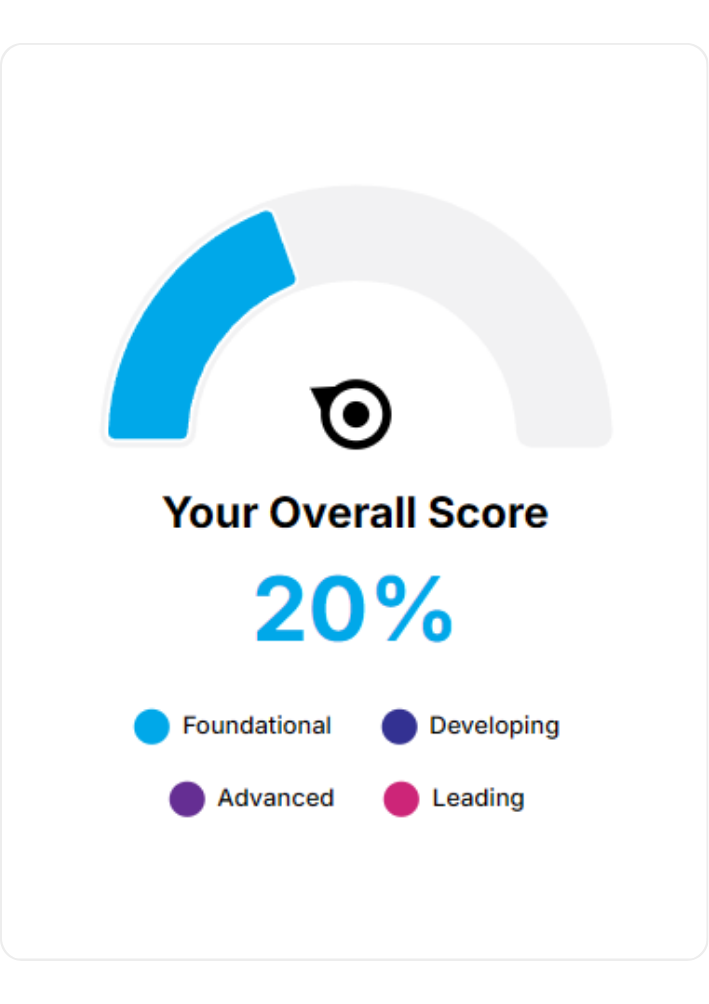
Impact measurement health check
How well are you measuring your impact? Take our FREE 5-min health check to find out